WharfClearLake.com
Appeals: The Error-Correction Department
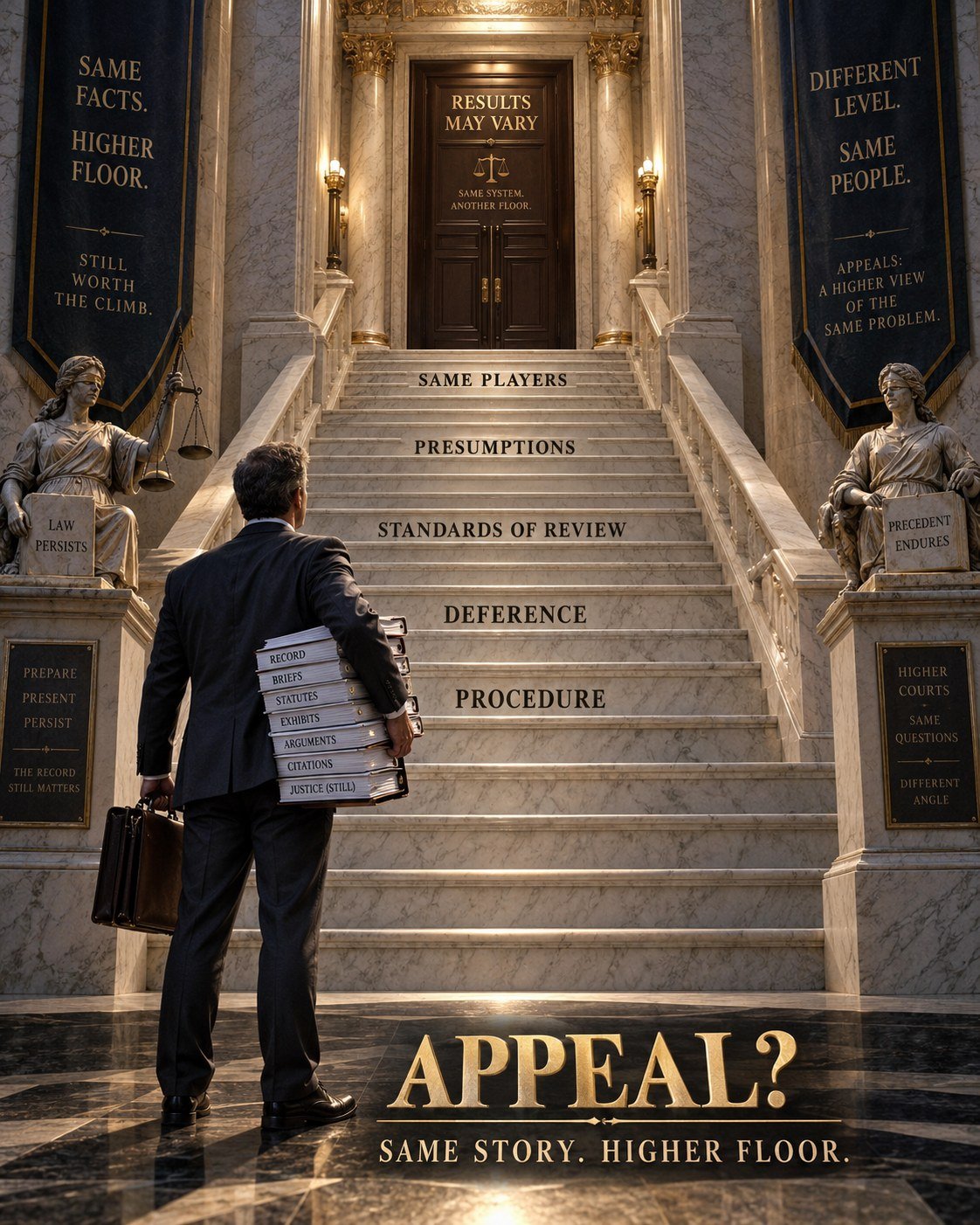
Editorial commentary. This essay discusses appellate structure and practical experience. It does not imply that an adverse appellate ruling proves misconduct by a trial or appellate court.
Appeals are often described as the part of the judicial system designed to correct legal error.
That description is true.
It is also approximately as complete as describing an airport as a place where airplanes land.
An appeal is not a second trial
Appellate courts generally review what happened below through a defined record, preserved issues, written briefs, standards of review, jurisdictional rules, and procedural deadlines.
Evidence that never entered the record usually cannot simply be introduced because it would make the story clearer.
An argument not properly preserved may become difficult or impossible to review.
A missing reporter record can affect review of what occurred at a hearing.
And even a preserved error may not produce relief if the reviewing court concludes the error was harmless or outside the scope of review.
Error correction comes with an intake form.
The record is the appellate universe
For a person unfamiliar with appellate procedure, one of the strangest lessons is that what happened and what can be reviewed are not always identical categories.
The appellate court works from the record.
If the critical event occurred in a hearing but the reporter record is unavailable, incomplete, unaffordable, or procedurally excluded, the reviewing court may face a very different universe from the person who sat in the courtroom.
This is why disputes over records are not administrative trivia.
They can determine what the appellate court is capable of seeing.
Standards of review matter
Appellate courts do not reconsider every issue from scratch. Different questions receive different levels of deference.
Some legal questions receive relatively independent review. Other rulings are reviewed for abuse of discretion or under standards that give substantial room to the trial court.
This means an appellant can persuasively argue that another outcome would have been better and still lose because the legal question is narrower: was the ruling outside the permissible range?
The distinction is doctrinally important.
It is emotionally less satisfying.
Procedural correction can become procedural litigation
An appeal intended to correct a procedural problem can itself generate procedural disputes about the notice of appeal, record, briefing, jurisdiction, deadlines, security, indigence, formatting, or preservation.
The correction department, in other words, has procedures for requesting correction of the procedures used to request correction.
Efficiency has many forms.
Why the appellate record on this site matters
WharfClearLake.com collects appellate opinions, briefs, record disputes, and procedural histories because a one-line statement that an appeal was “dismissed,” “affirmed,” or “denied” often does not explain what issue was actually reviewable.
Readers should ask:
- What order was being appealed?
- Was it final and appealable?
- What standard of review applied?
- Was the reporter record available?
- Was the issue preserved?
- Did the appellate court reach the merits?
The practical lesson
Appeal is essential to a functioning judicial system.
It is not a magic reset button.
Its ability to correct error depends heavily on the record, preservation, jurisdiction, timing, briefing, and the standard of review.
The error-correction department is real. So is the paperwork required to enter the building.
From the Marina
Wharf Clear Lake photo archive