WharfClearLake.com
The Professional Legal Ecosystem
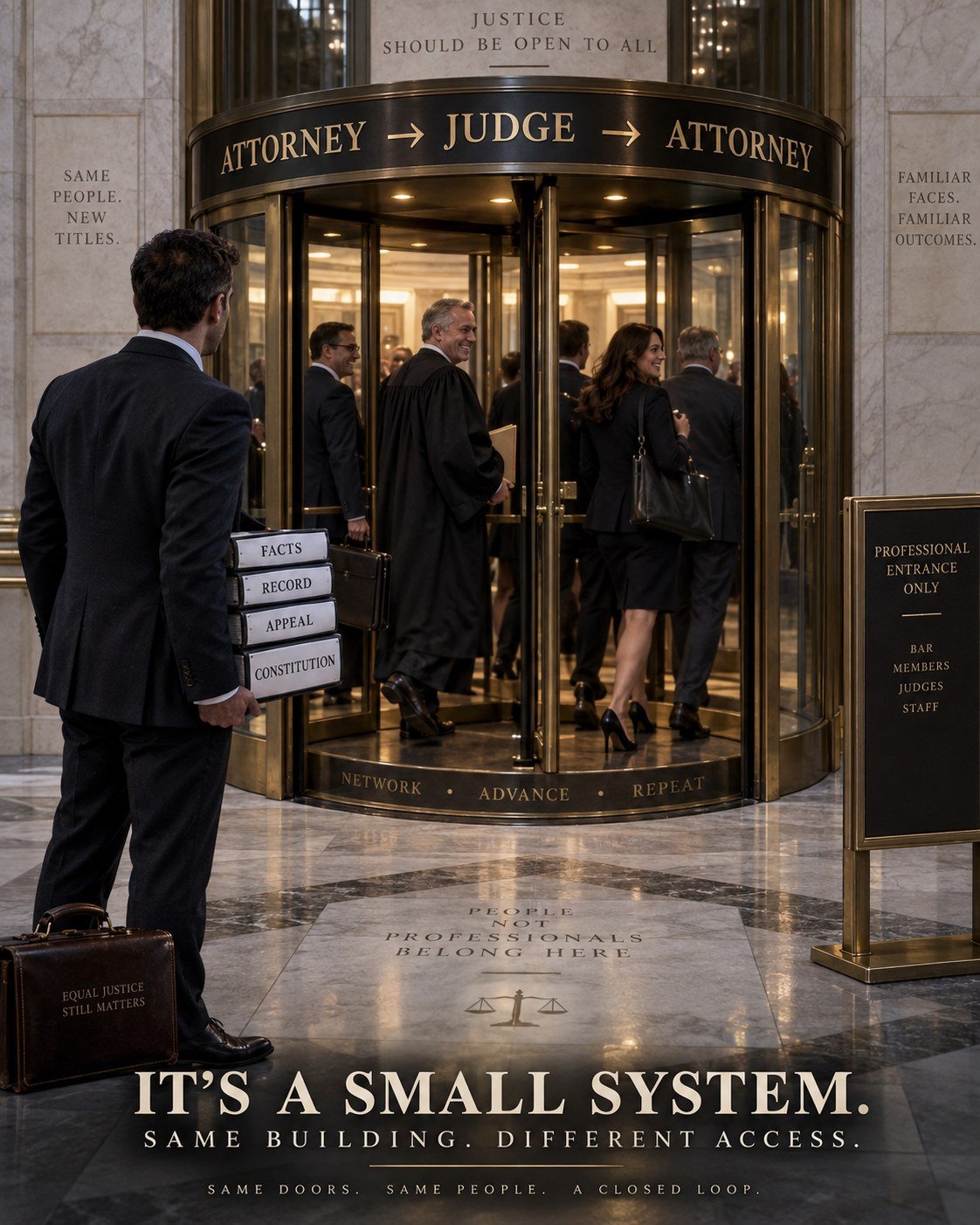
Editorial commentary. This page discusses institutional culture and professional familiarity. It does not allege improper private relationships or misconduct without evidence.
Every profession develops an ecosystem.
Doctors understand hospitals. Pilots understand airports. Contractors understand permitting departments.
Lawyers understand courts.
That familiarity is not inherently improper. It is what professional experience looks like.
The difficulty begins when an institution built largely by professionals, for professional use, is also expected to be equally navigable by ordinary people exercising a lawful right to appear without counsel.
The insiders are not secretly insiders
Judges are generally lawyers. Attorneys practice before judges. Clerks interact with attorneys. Court reporters work inside proceedings. Appellate staff read professional briefs.
This is not a conspiracy.
It is the architecture of the institution.
But architecture shapes experience.
A professional participant recognizes the vocabulary, sequence, expectations, unwritten customs, and procedural danger signs. An outsider may recognize only the dispute that brought them there.
Institutional familiarity creates comfort
People naturally communicate more efficiently with others who understand the same professional shorthand.
A lawyer can say “preservation,” “interlocutory,” “mandamus,” “abuse of discretion,” or “record deficiency,” and everyone in the room immediately understands the procedural neighborhood.
A self-represented litigant may instead explain the underlying event in ordinary language and expect the institution to identify the corresponding legal framework.
Sometimes it does.
Sometimes it does not.
The courthouse offers translation services for many languages. Procedural English remains largely BYO.
Why perceptions of bias develop
When the represented side communicates in familiar professional form and the self-represented side repeatedly encounters procedural barriers, the result can feel less like neutral adjudication and more like institutional preference.
That perception does not establish actual bias in any particular case.
It does, however, deserve more serious consideration than simply dismissing every concern as disappointment from someone who lost.
Public confidence depends not only on impartiality, but on proceedings that reasonably appear impartial.
Professional tribalism versus intentional favoritism
Institutional bias does not require a secret agreement.
Organizations can favor familiar practices, language, participants, assumptions, and routines without anyone consciously deciding to discriminate.
That is why the concept of institutional bias matters.
It asks whether the structure itself creates recurring advantages or disadvantages, not whether somebody exchanged a wink in a hallway.
The useful question
The better inquiry is not, “Are all judges and lawyers part of a conspiracy?”
That question is dramatic and mostly useless.
The better inquiry is:
Does the structure of the legal system create practical advantages for professional repeat players that can materially affect an unrepresented person’s access to meaningful review?
That is a serious institutional question.
It can be examined without pretending that every adverse ruling is corrupt or every lawyer is receiving special treatment.
The record belongs in the discussion
The court records, briefing disputes, transcript issues, access questions, and procedural outcomes collected on this site provide concrete material for evaluating those concerns.
Readers do not need to adopt the site’s editorial view.
They do need more than a slogan about equal justice to evaluate whether the institution delivered it.
An ecosystem can be perfectly ordinary to the creatures that evolved inside it.
From the Marina
Wharf Clear Lake photo archive