WharfClearLake.com
The Courtroom Is Not a Level Playing Field
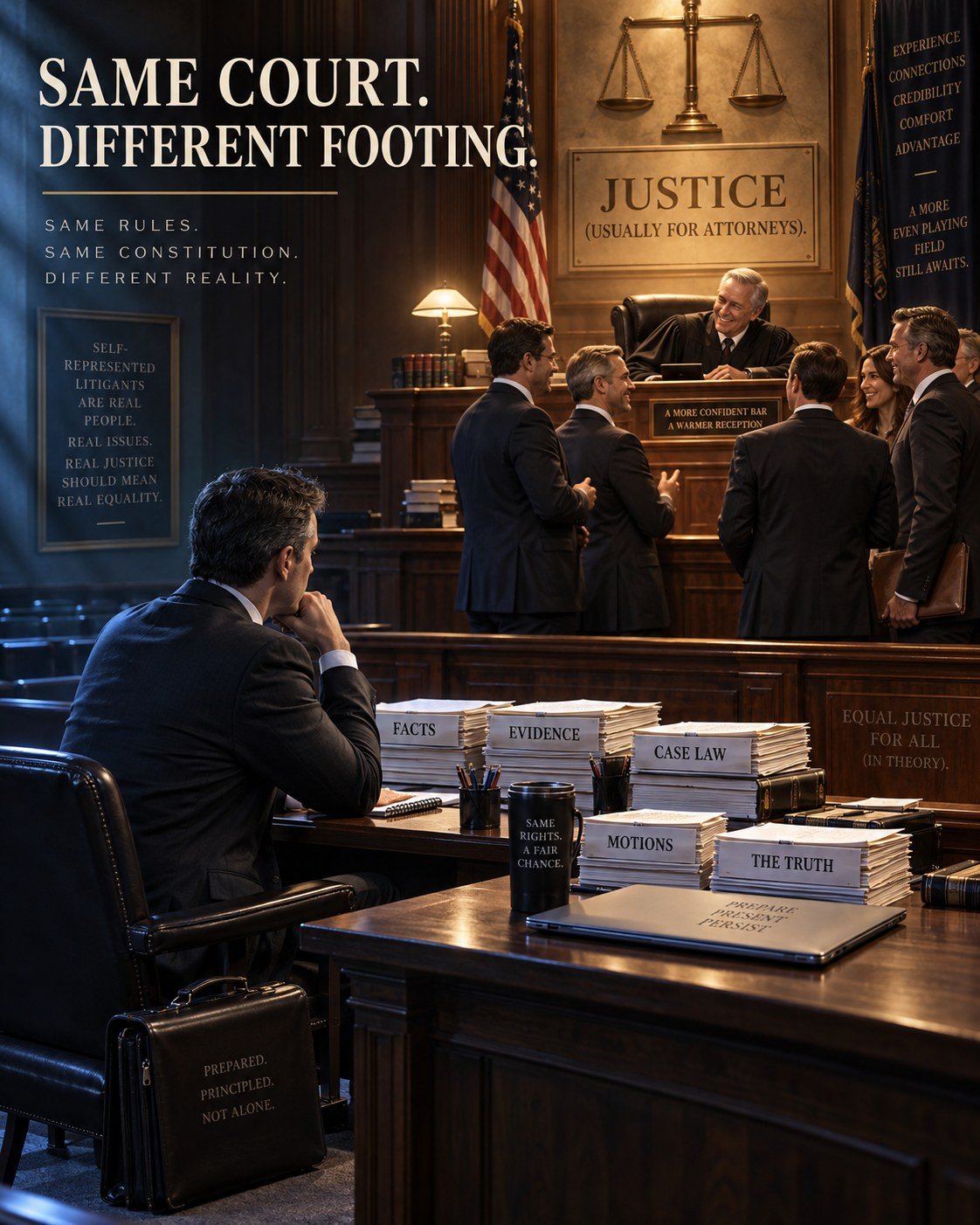
Editorial commentary. This essay addresses institutional structure and practical litigation experience. It does not claim that every judge favors attorneys or that every represented party receives preferential treatment.
The phrase “level playing field” appears often enough in discussions of justice that one might reasonably expect to find it somewhere between the witness stand and the clerk’s desk.
It is usually not there.
A courtroom can apply the same written rules to everyone while still giving radically different practical advantages to the people who know how the machinery works.
Professional familiarity matters
Lawyers speak the language of the institution. They know which arguments belong in which motion, which objections must be preserved, what belongs in the record, when a defect can be cured, and when a seemingly minor omission may become fatal later.
They also know something less visible: how courts tend to operate in practice.
None of that is sinister. Experience is valuable in every profession.
But when one side possesses years of professional familiarity and the other side is learning the system while simultaneously trying to protect property, money, access, or reputation, describing the situation as perfectly equal can become more aspirational than descriptive.
Repeat players and institutional comfort
Judges, lawyers, clerks, court reporters, and appellate staff work within the same legal ecosystem. They understand its vocabulary, conventions, rhythms, and unstated expectations.
A self-represented litigant enters as an outsider.
That does not prove bias. It does create asymmetry.
And asymmetry matters most when a decision turns not on the obvious factual dispute but on preservation, jurisdiction, timing, record completeness, briefing standards, or procedural posture.
The law may be neutral. The institutional fluency is not evenly distributed.
The comfort of procedural normalcy
Courts understandably prefer arguments presented in familiar form. Familiarity makes complex work easier.
The problem arises when unfamiliar presentation begins to overshadow substance.
A court may confront two versions of the same basic dispute: one delivered in polished professional language and one delivered by a property owner who knows the facts intimately but does not spend forty hours a week converting ordinary English into procedural dialect.
The written rule may treat both equally.
The human institution still has to process them.
Institutions, like people, tend to find fluent speakers easier to understand.
Why this matters in the Wharf record
The record collected on this site includes recurring disputes involving jurisdiction, appellate preservation, reporter records, recusal procedure, security requirements, access to review, and distinctions between procedural and merits rulings.
Those are exactly the kinds of subjects where institutional fluency matters most.
When a reader sees that a self-represented litigant lost, the useful question is not simply, “Who won?”
The better questions are:
- What issue was actually decided?
- Was the underlying merits question reached?
- Was review limited by the record or procedural posture?
- Was a defect curable?
- Did the ruling concern jurisdiction, standing, preservation, timing, or substance?
Those distinctions are less dramatic than a headline.
They are also considerably more informative.
The practical conclusion
A courtroom does not need to be intentionally unfair for the terrain to be uneven.
Professional familiarity, procedural complexity, repeat-player experience, and institutional culture can create substantial advantages without anyone announcing them from the bench.
The playing field may be technically open to everyone. That does not mean everyone arrives wearing the same shoes.
From the Marina
Wharf Clear Lake photo archive